Ranked Among Australia’s Top 20 Corporate Training Providers (2026): View Courses

Author: Rosy King

Adobe InDesign Tips for Marketing Pieces that Shine

11 Adobe InDesign Tips to make the most of your Software


By: Corporate Training Options, Australia

Adobe InDesign Tips and Trick can help you create awesome marketing materials.

Adobe InDesign Tips give you new ways to make the most of your software.  InDesign is fantastic for making posters, flyers, brochures, presentations e-books, and more. It is functional, easy to use and with a little training and know-how, gives you professional results every time. There are some great little-known features in InDesign. Here are some Adobe InDesign tips you can use today.


  1. Use the Find / Change Feature

The find/change feature in InDesign works the same way as find and replace does in word processing. The command can be found under the Edit menu.

Using the buttons on the right-hand side of the tool allows you to navigate your document and make changes to the text while the tool is open. You can even find and change the formatting of your document.


  1. Balance Ragged Lines 

This tool can make your paragraphs shorter and easier to read. It can be toggled on and off.


  1. Page Numbering System

When you add automatic page numbering to your master page, it appears on each page of your document.


  1. Flow Text Boxes

You can flow text boxes throughout all pages of your InDesign document. If the amount of text in the text box is larger than the size of your box a red plus sign appears in the text box.

To add a new text box, click on the plus sign, draw a new box and the text will fill this new box.


  1. Place images

To place images, you can use File > Place in InDesign or drag and drop images into your InDesign document. Add single images or bring in multiple images at once.


  1. Compound Path Frames

With compound path frames you can place a single image in multiple frames for a visual effect.

Select the Ellipse, Polygon or rectangular frame tool and create two or more frames.

Choose the selection tool and shift-click on each frame.

Choose objects > paths > make compound paths.

Go to file, place and select your chosen image and then click on open. Adobe InDesign automatically places the image inside your new frames.


  1. The Eyedropper

The eyedropper colour theme in InDesign has an extra feature that allows you to select a complete colour group rather than selecting a single colour.

Click anywhere on your InDesign document and the program will recognise close colours and create a palette of five colours.


  1. Shading Paragraphs

Paragraph shading is new to InDesign. A solid colour box is placed behind a text box and the selection is treated as a single unit. Alternatively, you can create a shape and place it behind your text.


  1. Link Files to Your Document

Linking external files means you can add images into your InDesign pages, while the file still remains separate. The shortcut for placing files is Command D.


  1. Copy Effects to a Separate Object

When you have created effects on an object and want to create the same effects on a different type of object, use the Effects Tool.

Select the object that you want to copy then open the effects panel.

Click and drag the object effects icon (shown as fx) onto your new object.


  1. Customise Your Links Panel

The links panel shows you not only more information about your links but also the exact information that you wish to see.

Click the links panels flyout menu and then panel options.

Apply checkboxes to the information that you want to see and press on OK to apply changes.


Want to know more about learning or mastering Adobe InDesign?


At Corporate Training Options our Adobe InDesign courses will teach you how to create professional looking documents for your company whether you are a novice or already have a high level of experience in the program. We have both introduction and advanced courses. You can get a quote for your training or to book with us today, directly from the CTO website.

Click here for a quote.

Click here to book.


About Corporate Training Options

Corporate Training Options is an Australian Professional Development and IT Training Company, which provides customised training courses Australia-wide. The courses provide a cost effective way of ensuring you and your staff are making the most of your software applications.

CTO’s Computer Training courses are customised to meet your requirements, and your training is provided on-site, on dates which suit you.

We look forward to working with you, to build your confidence in using your computer software.


For more information on the range of Computer Training Courses available, please visit the CTO website – cto.com.au


Rosy King

Corporate Training Options

Professional Training  –  Exceptional Results

training@cto.com.au

cto.noesis.chat/


Prepare for your CTO Computer Training

Your 5-Point Computer Training Plan

You 5-Point Computer Training Plan – when you need training for your team.

By: Corporate Training Options, Australia

A Computer Training Plan is important for all of us.   Especially if you have recently installed new software, or upgraded to a new version of your software.

If you’re in charge of organising workplace training sessions for your team, then this 5-Point Computer Training Plan will help you prepare for it.

Successful Training is planned in advance

Training your staff effectively is critical to your teams’ ongoing education, their job satisfaction, and their ability to achieve in their role. It’s also a strategic investment in the long-term success of your organisation.


The most effective training sessions are well-planned and prepared in advanced.  Once you have booked you computer training course with CTO, you can then work with your trainer to plan your course to suit your requirements.

The points covered in this training preparation plan will help you arrange an effective computer training session. It will also ensure your training runs smoothly, to deliver the best return on your investment.

  1. Advise us of your specific needs

The benefit of booking in-house computer training with CTO, is that the training can be customised to suit the specific needs of your organisation. It therefore will be beneficial if you can fully brief CTO on your requirements, prior to your training session.

Produce a list of key topics that need to be covered.  You can create this list by discussing the matter with the trainees attending the course, their manager, or someone in your organisation who already has the skills the attendees are looking to acquire.

Send examples of your work to CTO before the training.  This will give your trainer a good idea of the kind of documents your staff will need to create or edit. We can then incorporate your documents into practical exercises for your course.

For example, if your staff are learning how to create corporate brochures, the trainer could assist them to create pages from some of your typical brochures during the training.  This will allow your trainer to check that your trainees are mastering the relevant techniques.

  1. Plan your training area

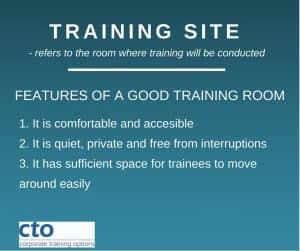
Set up a suitable area where you can conduct your computer training session.   This needs to be an environment where the trainees can concentrate on learning without interruption or distraction.

If your organisation does not have a training room, then a meeting room can be adapted for the purpose. Delegates should be able to comfortably see the trainer from their seats.

Each trainee should have the use of their own workstation or laptop for the duration of the course and enough space to use it.

A computer connected to a data projector for the trainer is extremely useful. A group of 1-3 trainees can easily gather around a shared computer screen.  However, groups of 4 or more will find a data projector necessary.  A whiteboard and pens are also helpful.

  1. Your Training Software

The correct version of the software should be loaded on each person’s computer and, ideally, everyone should be using the same version of the software. For example, running a course on Microsoft Excel where some delegates have Excel 2013 and others Excel 2016 could be challenging, since there are differences between the two versions.

However, rest assured that if you do have different versions of the software in your business, your CTO Trainer does know both versions, and will be able to manage the training for your team, pointing out the version differences during the course.

  1. Brief your training delegates

For your computer training to be effective, delegates must be available for the duration of the course.  They should ideally be off-limits to other members of staff. One way to achieve this is that they should be treated as absent from the office, until their course ends.

Equally, they should be motivated to do the training and agree that it will benefit them.  They need to believe that acquiring the new skills provided by the training will help them to work more effectively.

It’s not a good idea to add a few extra bodies to a training session just to make up the numbers. It is far better to include just those delegates for whom the training will be relevant and useful.  More focussed, smaller groups also allows your trainees to receive more personal attention from the trainer.

  1. Timing

Finally, to be effective, in-house computer training should be timely. Computer users should attend a course at a time when they are about to start using the software or using it in some new or more advanced manner. Immediately following their training, they should also have the opportunity to implement what they have learned.

They should have the software available on their own computers and there should be a requirement for them to use it as part of their daily routine.

If they don’t actually use the software for weeks or months after attending a course, the benefits of the training can be almost entirely lost.  This may lead to them needing to repeat the training session.

You can improve your computer skills with CTO’s extensive range of computer training courses, covering software that is used in business organisations around the world.

For more information on the Computer Training Courses available, please visit the CTO website – cto.com.au

With just a little advance planning, you can achieve a great return on your investment in training for your team.

About Corporate Training Options

Corporate Training Options (CTO) is an Australian Professional Development and IT Training Company, which provides customised, workplace training courses Australia-wide.

The courses provide a cost-effective way of ensuring you and your staff are making the most of your software applications.

CTO’s Computer Training courses are tailored to meet your requirements, and your training is provided on-site, on dates which suit you.

We look forward to working with you, to increase your productivity and  build your confidence in using your computer software.

For more information on the range of Computer Training Courses available, please visit the CTO website – cto.com.au

Rosy King

Corporate Training Options

Professional Training  –  Exceptional Results

E: training@cto.com.au
W: cto.com.au


Facebook Ads Training

2.2 Billion Reasons why you need Facebook Ads

Ramp up your Facebook Ads results with the CTO Facebook Ads Checklist

By: Corporate Training Options, Australia

Trust me – you need Facebook ads for your organisation.  Facebook is without a doubt one of the most effective forms of advertising and marketing. Worldwide, there are over 2.2 billion monthly active Facebook users, making it the most successful and popular form of social media advertising.

People spend, on average, 30% of their online time on social media, with the average time being spent on Facebook nearing an hour each day. With a market such as this at your disposal, can you really afford not to use it?

Content is fire. Social Media is gasoline.– Jay Baer, Founder of LinkedIn

Plan your Facebook Ads Campaign

CTO has now created a Facebook Ads Checklist to make sure you get your important Facebook marketing tasks done. Facebook can be distracting and you need to remember when you are on Facebook, that you are there to market your organisation.

Use our Facebook Ads Checklist as a guide to keep you focused

There are now a wide range of options available when it comes to Facebook advertising campaigns, so you need to decide on your goals before you start your campaigns. What are you looking to achieve? It may be clicks to your website, conversions, likes, content exposure or brand awareness. Keep the end result in mind when you plan your campaign.

Ensure you keep it Mobile Friendly

A huge 90% of people using Facebook use a hand-held device such as a mobile phone or tablet.  So be sure to keep your content mobile friendly.

So here it is.

The CTO Facebook Ads Campaign Checklist

Follow this checklist to bring a percentage of the huge amount of traffic that is on Facebook every day, to your site.

  • Brainstorm 3-5 things that are unique selling points for your company

What makes you stand out?  What makes you different?  Why should customers buy your product or service?

  • What is the goal of your campaign?

Is it clear and measurable?

  • Choose engaging images for your Facebook advertising
  • Write your titles with clear calls to action
  • Write the content of your advertising

Consider your message. Is there a clear message that you want to get through to your audience? Does this message stand out in your ad? Who is your message for?

  • Name your campaign something meaningful so that you will remember it in the future

You can save each of your advertising campaigns in Facebook, so it’s wise to use a campaign name which explains at a glance what is is.  Use the month and the year in the filename. For example: Book sales – July 2018.

  • Create unique advertising combinations

Combine your text in different ways and test the ads to find out which type of ads get the most likes, clicks and sales.

  • Define your target audience

Test your Facebook ads in different age groups, locations, and interest groups.

  • Choose an ad type that meets your goals

There are many different types of Facebook ads, so it’s important to use the right ad type to match your desired campaign goals.

  • Set an advertising budget for your compaign

Ensure that your advertising budget is made clear to your team members who are involved in the campaign. Take the cost of the testing phase into account.

Decide how much you will pay per click. The higher the price the more clicks you will receive. Choose from cost per click (CPC) and cost per thousand impressions (CPM).

  • Define your ad set names

Divide every ad set into different audiences messages and pricing structures. All names on your ad sets need to be different and they should define the content. Make sure that the content is written to best suit your target audiences.

  • Check the ad sizes and optimal settings before you upload your ad

Facebook changes ad settings periodically, so ensure you have checked them before you upload your ad.

  • Test the campaign
  • Use the best results from your tests for your campaigns
  • Set dates for your Facebook Ads campaign

To gain a slice of the market of more than 2.2 billion users who are on Facebook every month, ensure you cover all 15 points on the Facebook Ads checklist each time you plan a new campaign.

You can also improve your current Facebook marketing skills with CTO’s Facebook Ads for Business Training.

To book your training today:

  • Click here to see the topics covered in the hands-on training, and receive a quote
  • Click here to book your onsite, customised training – and have an ad campaign up by the end of the day!

About Corporate Training Options

Corporate Training Options is a Business Education Training Company, which provides customised Professional Development & Business Technology courses Australia-wide.

The courses provide a cost-effective way of ensuring you and your staff are presenting your best image to the world.

CTO’s Facebook Ads for Business training course is customised to meet your requirements, and your training is provided on-site, on dates which suit you.

We look forward to working with you, to build your confidence, improve your efficiency and maximise your potential.

For more information on the range of Corporate Training Courses available, please visit the CTO website – cto.com.au

Rosy King

Corporate Training Options

Professional Training  –  Exceptional Results

training@cto.com.au

cto.com.au


CTO Training Courses - Teaching you essential skills for the workplace

5 Business Finance Essentials you Need to Master

There are 5 Business Finance Essentials you need to master.  

By understanding these 5 key business finance essentials, you can increase your company’s efficiency, market share & profits.

By: Corporate Training Options, Australia


CTO Training Course - Business Finance Essentials
CTO’s Business Finance Essentials Training Course will teach you to understand and manage your business finances

Financial intelligence is essential in business.  However, when it comes to understanding crucial aspects of your company’s financial statements and budgets, you may not be very interested.  Maybe sales targets, marketing plans or product development are more your thing.

At Corporate Training Options we know that examining your company’s income statements, balance sheets, cash flow statements and budgets, may not be your idea of fun.  But, having an understanding of your businesses finances does in fact have many benefits.


Once you have a firm understanding of business finance essentials you will be able to:

  • Discover areas of opportunity for company growth and increased market share
  • Be able to identify trends and make sound competitive evaluations
  • Work with your team to keep your business reaching new goals
  • Maximise efficiency in your business, based on targets set by knowing your numbers
  • Be more confident in making decisions for the business
  • Better manage your budgets, gain knowledge of competitors, forecast future profits
  • Understand valuable information about your company’s ability to generate revenue, meet financial obligations and manage debt


So here are the 5 Business Finance Essentials you need to Develop & Master

1.        Design and Run Financial Reports

The ability to design and run financial reports for your company gives you a wealth of information at your fingertips.

Financial Reporting provides you with essential information on:

  • Income
  • Expenses
  • Product Sales
  • KPIs
  • Salaries
  • Staff hours
  • and more

Custom reports can be designed specifically for individual departments. The ability to report at the touch of a button allows you to make changes to your workflow and set and achieve specific financial goals for the business.


2.        Learn to Understand Financial Statements

Gaining expertise in reading the company income statement, balance sheet, and cash flow statements, allows you to then analyse these financial statements to determine income, expenses, profit and loss, cash flow projections and more.

Having an understanding of key financial statements allows you to make improvements in the business, which in turn leads to improvements in the bottom line.

By being able to thoroughly examine your financial statements using reports and financial ratios, you’ll obtain valuable information about your company’s ability to generate revenue and meet financial obligations.


3.        Know how to Create and Manage Budgets

Although budgeting may be one of your least favourite things to do, it is necessary for effective financial management. Budgeting and costing are key components of business finance essentials.

By learning and increasing your budgeting knowledge and skills, you and key members of your team can prepare and monitor budgets, manage cash flow for profit and evaluate which areas in the budget can be reduced or expanded to maximise profit and growth.


4.        Identify Trends and conduct Competitive Evaluations

Being able to identify trends and conduct competitive evaluations of your industry, is an important aspect of your company’s strategic planning.  It is used to establish and monitor various trends in your business financials.

Trend evaluation also supports and gives you in-depth information about how your company can be more competitive, and help you plan your company’s strategies, tactics and goals.

Learn to use your financial statements to conduct both trend evaluations and competitive evaluations.


5.         Learn and Understanding Financial Formulas

Understanding financial formulas helps you assess your company’s performance in many key areas and can also help you with company investments.

By learning, exploring and understanding your company’s financial formulas, including your Break Even Point, Operating Margin and Inventory Turnover Ratio, you will be able to easily track and monitor your company’s performance to identify what is working, and which areas need to be changed.


Financial intelligence is essential in business — and tracking and managing your finances is necessary for prosperity and profit.

So how do you improve your financial intelligence

  • Attend Training – This is the best way to learn how to take control of your finances. Training can improve your understanding of your finances, increase your financial literacy and ensure you’re fully informed before making financial decisions.
  • Learn Financial Terminology – Learn the terminology, as this will give you a better understanding of your financial statements.
  • Ask lots of Questions – If you don’t understand some areas of your financials, please ask.  There are experts out there who can assist you, including your Accountant and/or Business Advisor.


When you’re building a company, you need to continually strengthen every component – finance, strategic partnerships, executive team, and relationships.

Michael J. Saylor


__

Corporate Training Options – Business Finance Essentials Course

The CTO two-day course in Business Finance Essentials teaches company leaders and team members the fundamental aspects of business finances.

We guide you through:

  • Basics of budgets
  • Ground rules of finance
  • How to read financial statements
  • Skills to evaluate business performance
  • Determining liquidity, profitability and solvency
  • The decision-making process involved in investments and project appraisal techniques
  • How changes in costs and volume can affect a company’s operating income and net income


The Business Finance Essentials course from CTO is ideal for accounts staff, team leaders, company Managers, and Directors.  Trainees require no prior financial knowledge.

For more information on how you and your company can operate more efficiently and maximise your profit through budgeting and understanding your businesses finances, please download the course outline – Business Finance Essentials.


About Corporate Training Options

Corporate Training Options is an Australian Professional Development Training Company, incorporated in 1992.

Our customised Professional Development courses are available Australia-wide, for business executives and corporate teams, and provide a cost-effective way of ensuring you and your staff are presenting your best image to the world.

CTO Professional Development Training courses are customised to meet your requirements, and your training is provided on-site, on dates which suit you.

We look forward to working with you, to build your confidence, improve your efficiency and maximise your potential.


For more information on the range of Corporate Training Courses available, please visit the CTO website here


Rosy King

Corporate Training Options

Professional Training  –  Exceptional Results


E: training@cto.com.au

W: cto.noesis.chat/


The Power of Business Etiquette and Professionalism

The Power of Professionalism, Courtesy & Respect in Business

By: Corporate Training Options, Australia

Having strong skills in business etiquette and professionalism is extremely important.

In your business dealings and in your workplace, it’s critical you and your team display a professional attitude and demeanour, and respect towards others at all times. You will also need to know the correct business etiquette for interacting with staff and clients in a variety of situations.

Professional situations can at times be awkward, however, with an understanding of business etiquette, even awkward situations can be managed well. However, many forms of business training simply do not cover etiquette and professionalism.

Business Etiquette & Professionalism Training

CTO’s business etiquette and professionalism course will teach your staff to present themselves in a polished and professional manner. When you are adept at business etiquette, others that you deal with in the work environment will take you seriously. Business etiquette is, essentially, proper behaviour in a business environment.

Here are some business etiquette tips you can use every day.

  • Tone of Voice

 Always use an even tone of voice. Never raise your voice to others around you and always use appropriate language. Speak to others in a respectful tone.

  • Remember People’s Names

Make an effort to remember the names of those that you work with and deal with regularly in your position.

  • Managers

Respect and courtesy should be shown to everyone at your workplace. Your managers in particular, should receive extra care in your communications with them. They should be made aware of your status on projects, and you should communicate to them any achievements or setbacks as soon as they occur.

  • Promptness

Always arrive at work and meetings on time, and inform management and co-workers if you will be out of the office. Return phone calls and emails promptly. Minimise personal phone calls at work.

  • Dress

Know the dress code for your organisation and ask for clarification on this if you are not sure. This goes for casual dress days too.

  • Office Decorations

Consider who will see your office adornments and what they say about you. Are they distracting, or could they be considered derogatory in any way?  Or do you have a clean, tidy, well presented and professional work space?

Professionalism

Professionalism in the workplace, and the professional qualities that a person and business portray, imply quality of service and workmanship.

A professional attitude will lead to a reputation for excellence and will reflect on both the individual and the organisation.

Business Etiquette and Professionalism in the Workplace
Be reliable, honest and conduct yourself with integrity at all times

Professionalism is needed when introducing yourself to those in the workplace, when speaking on the phone, and when dealing with peers and co-workers, suppliers and clients.

It can be difficult to know how to present yourself and your organisation professionally. Training in business etiquette will teach you how to do this easily and effectively, using real life examples and roleplays.

The Skills of a Professional

  • Always aim for excellence in your work

Do your work to the best of your ability at all times.

  • Conduct yourself with Integrity

Professionals have strong morals and principles. They are fair and trustworthy and portray these characteristics at their place of work.

  • Be Reliable

Always do what you say you are going to do. Do not under deliver.

  • Be Honest

When you are honest, people know that they can depend on you. They will feel that they can trust you, and your organisation.

  • Be Polite and Respectful at All Times

Everyone that you deal with, including managers, subordinates and workmates, should be treated with courtesy and respect. Always be polite.

  • Be Careful what you put in Writing

Much of our communication is now done by email and as such it needs to be scrutinised and checked before you hit the send button. Ensure that the tone, grammar and wording is appropriate.

  • Don’t Complain

Negativity at work can spread like wildfire if you allow it to. Resist the temptation to complain and commiserate with co-workers. Instead of talking and complaining about work issues, act professionally and work towards solving the issues.

  • Do not take Situations Personally

In the case of a difficult client, a misunderstanding with a co-worker or any other difficult situation, remain calm and try to separate the issue from the person. Remember that the situation is not a personal assault on you.

Training your team in Business Etiquette and Professionalism will result in:

  • increased morale in the office
  • fewer customer complaints
  • more confident team members
  • a greater level of staff retention
  • increased productivity
  • an improved perception of you and your business

Business etiquette and professionalism training will teach you and your team members to represent themselves and your organisation effectively and proficiently. It is beneficial for staff at all levels.

Click here for bookings and more information today!


Business Etiquette and Professionalism are important skills to know


Over to you! What are your thoughts or experiences about Business Etiquette and Professionalism?

We’d love to hear them or answer any questions you have, so please contact the Corporate Training Options team today.

Business Etiquette and Professionalism training

The above techniques on Business Etiquette and Professionalism are covered in detail in the Corporate Training Options course, so please contact us today for more information.

To book a Business Etiquette and Professionalism course for your team, please visit our website here

About Corporate Training Options

Corporate Training Options is an Australian Professional Development Training Company, incorporated in 1992.

Our customised Professional Development courses are available Australia-wide, for both business executives and corporate teams, and provide a cost-effective way of ensuring you and your staff are presenting your best image to the world.

CTO Professional Development Training courses are customised to meet your requirements, and your training is provided on-site, on dates which suit you.

We have over 300 qualified instructors on call in:

  • Sydney
  • Melbourne
  • Brisbane
  • Gold Coast
  • Canberra
  • Adelaide
  • Perth
  • Darwin
  • Hobart
  • New Zealand
  • United Kingdom
  • Canada
  • USA

Each CTO trainer has specific areas of expertise. This enables them to provide invaluable assistance to corporations like yours, seeking to maximise your investment in your teams.

We guarantee the highest possible standard of tuition, personalised to suit your exact requirements. By training onsite in your workplace, you are provided with a cost-effective way of ensuring you and your staff are able to improve your professional skills.

So if you’re ready to upgrade your skills, contact Corporate Training Options today for friendly, professional advice.

We’ll discuss your specific needs, and tailor a training course to suit your requirements.

For more information on the range of Corporate Training Courses available, please visit the CTO website here

Rosy King

Corporate Training Options

Professional Training  –  Exceptional Results

E: training@cto.com.au

W: cto.com.au


Xero Training for Super payments

Need Xero Training to Automate your Super?

Need Xero Training to Automate your Super?

If you need Xero Training to automate your Superannuation payments, then this article will assist you.  Xero’s Automated Super allows you to manage your superannuation obligations easily and efficiently.

About a week before your superannuation payments are due, a message icon will appear on the top right of Xero your screen.  This is one of the benefits of Xero.  It’s programmed to manage Australian businesses, and keeps us informed of when due dates are approaching.

That’s clever technology.

Get setup to manage your Superannuation

If you are not already setup to track and make Superannuation payments from your Xero software, it’s a fairly straight forward process, using Automated Super.

Auto Super is only available in the Xero Premium package, which is currently $60 per month.  It is not available in Xero’s lower priced packages.

If you are not already registered for Auto Super, just follow the instructions below.

Register for Auto Super

  1. In the Payroll menu, select Superannuation.
  1. Click Get Started to check your ABN and Legal/Trading Name are correct. If they are not correct, you can update these details in your Organisation Settings (Settings > General Settings > Organisation Settings)
  2. Select an authoriser and enter their name, phone, and email, then click Next.
  3. Select the bank account you will use to make direct debit payments for super for your employees, then click Next.
  4. Review the terms and conditions.
  5. Select the confirmation checkbox to agree to them.
  6. Click Register, and you’ve finished registering for auto super.

It may take a few days for your auto super to be activated, so ensure you do this prior to your Super payment due date

Manage your Super payments from the Payroll Admin Role

You will need to be a Payroll Admin user to manage auto super payments in Xero.  The Payroll Admin user role has full payroll access and can manage employee details and payroll settings, plus complete pay runs and run payroll and super reports.

The Xero subscriber for your business has the Payroll admin role by default.  Access can also be given to other users, who either have the Standard role, or are an employee of your business.

To give a user the Payroll Admin role:

  1. In the Settings menu, select General Settings.
  2. Click Users, then select the user’s name. Their existing role and permissions are shown.
  3. Under Payroll select the Payroll admin checkbox, then save.

Ensure all employees have a Super Fund allocated on their file

When a new staff member is added to your Xero accounts, part of the setup process is to ensure they have a superannuation fund allocated.  If this is your first time paying superannuation for your employees, you should check that everyone’s super details are recorded in Xero.

To check if all employees have their Superannuation details entered:

  1. In the Payroll menu, select Employees.
  2. Select each employee from the list by clicking on their name.
  3. When the employee file opens, click the Employment tab.
  4. Under Superannuation Memberships their Super Fund details should be listed.


If super details are not on an employees’ record, you will need to do two things.  Firstly, add their super fund to your Xero file.  Secondly, allocate their super membership in their fund from the employee record.

Add a Super fund to Xero

Add the super fund for your employee in Xero.

  1. In the Settings menu, select General Settings.
  2. Under Features, click Payroll Settings.
  3. Click the Superannuation tab.
  4. Click Add Superannuation Fund.
  5. From Type, select Regulated Superannuation Fund.
  6. From Name, start typing the fund name or USI and select the fund from the list that appears.
  7. If you have an employer number, enter it in the Employer Number field.
  8. Click Save.

Enter Super membership for employees

After you’ve added super funds to your payroll settings, add fund information to new employees or existing employees who aren’t already making super payments.

  1. In thePayroll menu, select Employees.
  1. Click the employee’s name to open their details.
  2. From the Employment tab, click Add a super membership.
  3. Select the employee’s super fund from the Fund list.
  1. Enter the employee’s membership number.

If you don’t know the employee’s fund yet, leave the employee’s membership details blank. Xero allocates any accruals to Fund Details Pending. They move to the new fund when you update the super details later.

  1. Click OK, then click Save.

Create your Super payment

You are now ready to make your superannuation payment.

  1. In thePayroll menu, select Superannuation.
  1. Click Add Super Payment.
  1. From the payment details page, choose the lines to pay from the list of posted pay runs.

You can filter this list by employee, super fund, employee group or payment due date by clicking on the column headings.

  1. Once you’ve selected your lines for inclusion in the payment, click Submit for Approval.

You will be redirected to the superannuation home screen where the payment will appear as ‘Pending authorisation’.

If you are the nominated payroll admin authoriser, you will receive a text from Xero with the authorisation code, which is valid for 24 hours. Xero will also send an email letting you know the SMS has been sent.

Authorise your Super payment

Once you’ve received your SMS with the code to approve your super payment, you can go ahead and make the payment.

  1. In the Xero Payroll menu, select Superannuation.
  2. Click on the payment which shows as ‘Pending Approval’.
  3. Review the list of super payments included in the batch.
  4. Click Approve & Submit, then enter the authorisation code you received in the SMS.

Once you’ve authorised the payment, it will appear as ‘Approved, pending processing’.

The payment details are then sent off to Xero’s third-party superannuation clearing house. They will direct debit your authorised bank account with the total amount payable and distribute the payments to your employees’ super funds. Once accepted, the status will change to ‘Processed’.

Reconcile Super payments

After you’ve made your super payments, the transactions will show on your bank statement. Rather than reconciling to a bill, allocate the payments directly to your payables account, which will reduce the balance outstanding.

  1. Go to the Dashboard.
  2. Choose the bank account your super payments were paid from and click Reconcile Items.
  1. Find the statement line for your super payment.
  2. On theCreate tab on the right-hand side:
    • In theWho field, enter the name of the super fund.
    • From theWhat dropdown, select your superannuation payable account.
    • In theWhy field, add a description.
    • Click OK to reconcile.

A super accrual amount is included within your payroll bill, allocated to your super payables account.

The benefits of Xero training to manage your Super payments

When you undertake Xero training with CTO, your expert Xero trainer can answer all the questions you may have in relation to the setup and management of your superannuation accounts.  Your training will also ensure that you soon reap the benefits of understanding and using your Xero business accounts more effectively.

Xero gives you simple tools to easily manage your payroll and super payments.  Training in Xero can also teach you how quick and easy it is to reconcile your bank accounts and credit cards each day, how to handle inventory with ease, manage your BAS payments, access your business financial statements, and more.

Xero training ensures you are always on top of your business accounts, and have a better understanding of the direction your business is heading.

How will you be using Xero today?

When you are ready for Xero Training, CTO can provide you with onsite training, customised to suit your requirements.

The courses are available one-on-one or for a group of trainees, and cover a range of skill levels, including:

–  Introduction to Xero

–  Advanced Xero

–  Xero Payroll training

Click here to view the Xero courses available from Corporate Training Options.

About Corporate Training Options

Corporate Training Options is an Australian Professional Development Training Company, incorporated in 1992.

Our customised Professional Development courses are available Australia-wide, for business executives and corporate teams, and provide a cost-effective way of ensuring you and your staff are presenting your best image to the world.

CTO Professional Development Training courses are customised to meet your requirements, and your training is provided on-site, on dates which suit you.

For more information on the range of Corporate Training Courses available, please visit the CTO website here

Rosy King

Corporate Training Options

Professional Training  –  Exceptional Results


E: training@cto.com.au

W: cto.com.au


6 Tips for Effective Communication

6 Tips for Effective Communication 

Brought to you by Rosy King @ Corporate Training Options

Effective Communication is a Vital Life Skill.

Effective communication skills are vital to creating positive relationships and to resolving conflicts in the workplace.  Excellent communication skills are also essential to achieving productive and meaningful interactions with your team.

However, effective communication is more than just transferring information from one person to another.  It’s about understanding the message behind what is being said.  In face-to-face communication, not only are words and tone important, but non-verbal clues can be key to getting the message across to your audience.  Good listening skills are also one of the most important factors in human interaction.

The Problem

It would seem to be relatively simple.  You have a message you need to convey.  You present the information, you are heard by your audience and you believe you are understood.  However, ….

Fast Fact:  46% of employees leave a meeting not knowing what they’re supposed to do next.

The Solution

You need to ensure your face-to-face communication is clear, concise and absolutely understood by those receiving your message.  So here are 6 tips you can use every day to ensure your face-to-face communication is effective.

  1. Appreciate the advantages of face-to-face communication
  2. Learn to understand non-verbal messages
  3. Choose your words carefully
  4. Use active listening
  5. Introduce creativity in your communications
  6. Adapt your face-to-face communication skills to other communication forms
  7. The Importance of Face to Face Communication

Recognise the impact of face-to-face communication and appreciate the advantages over email, text or phone.  Direct communication allows you to not only convey or receive information via spoken words, but to factor in such things as individual behaviours, and personality preferences.  Being in the same room as your team, instead of at the other end of an email chain, promotes understanding, further discussion and problem resolution.

Fast Fact:  26% of employees think email is a major productivity problem

  1. Learn to understand Non-verbal Messages

It’s important to understand the value of the unspoken communication in the room.  Be aware of your own body language when you are delivering a message.  Be aware of the body language of your audience when they are receiving it.

A person’s demeanour can greatly influence how the recipient interprets the message. When you speak in an even tone with direct eye contact, and a friendly facial expression, your message is likely to be received as positive or at least neutral. Body language that communicates negative feelings, such as crossed arms, lack of eye contact, clenched fists and a serious expression, is likely to be interpreted in that context.

For effective communication you need to be aware of your own body language.  You can also do simple things to make your team more receptive to your message.

  • Check your physical appearance prior to your meeting
  • Consider the spatial arrangements in the room to ensure everyone has enough personal space, but still fees involved
  • Deliver your message in a timely manner
  • Take advantage of your tone of voice, to deliver challenging messages in a constructive way
  • Don’t use the incorrect tone, as this can stop your message from being understood. For instance, you wouldn’t use a cheerful tone when delivering a disciplinary message.

Fast Fact:  55% of communication is body language, 38% is the tone of voice, and 7% is the actual words spoken

  1. Choose your Words Carefully

Realise that your words have an impact.  In order to create a positive impression, you need to deliver your message in a clear and concise manner and phrase your words in a business context.  Also, keep your language up to date, as popular words and phrases come and go on a regular basis.  If you have to deliver bad news, it is crucial that you do this without creating conflict or damaging trust in the workplace.

Also remember that last words linger – so don’t waste them.  The last words you say provide you with the opportunity to embed your message into the minds of your listeners.  Have a strong, relevant ending to your message, as this will boost your credibility, satisfy your audience and increase their trust in you. If you require action from your team, ask for it.  Deliver a call to action, or provide them with how-to steps.

Fast Fact:  Your last words crystallise your message and activate your audience.

  1. Use Active Listening

Remember that effective communication is a two-way information sharing process.  When you send a message, it needs to be easily understood by the receiving party.  When they respond with comments and questions, active listening helps you process messages in a focused manner and respond in a way that encourages and furthers communication.  This method allows both you and the recipients of your message to remain engaged, indicate understanding and clarify any points without interjecting or arguing.

Active listening involves eye contact, open body language and often the reframing of the message to confirm understanding.  In order to actively listen you need to:

  • Be present and attentive
  • Give the speaker your full attention
  • Mentally screen out distractions like background activity or noise
  • Face the speaker and maintain eye contact
  • Keep an open mind and listen without judging or jumping to conclusions
  • Try to picture what the speaker is saying and feel what they are feeling
  • Don’t interrupt and don’t impose your own solutions
  • Wait for the speaker to pause to ask clarifying questions
  • Provide feedback and rephrase what has been said to show you understand the message

Good leaders know how to ask the right questions and then listen with both their eyes and their ears.  You need to read between the lines and listen and hear what is coming back to you.  Look for the nonverbal clues, because often body language will tell you what you need to know

Fast Fact:  Most people usually only remember about 17 to 25% of the things they listen to.

  1. Introduce Creativity in your Communications

It’s important to introduce creativity into your communications to keep your recipients engaged.  Try these ideas to mix it up a bit and feel more connected with your team.

  • Go for a walking meeting, to increase energy and creativity
  • Hold monthly team events which are fun and help build team relationships
  • Hold friendly competitions in the workplace – they don’t have to be work related

Increasing creativity in communications can have a powerful effecting in creating a more collaborative and transparent atmosphere, making your employees feel more connected and engaged.

Fast Fact:  Productivity improves by 25% in organisations where employees feel connected

  1. Adapt your face-to-face communication skills to other communication forms

Think about how much more you get out of face-to-face communication than communication that is just based on email or telephone calls.  There are so many visual cues in a face-to-face communication that it’s hard to deny its effectiveness.

How many times have you had miscommunication with someone via email or telephone that would not have occurred had you been speaking directly with one another?  When you are able to see the person to whom you are speaking, you receive visual cues on whether or not they understand what you are saying and you give them visual cues as well.

However, there are times when email or phone calls are your only option, so you need to manage these communications as well as you can.  Here are some tips for effective communication on the phone, or via email.

  • Prepare for the call, or draft your email before sending
  • Be clear about what you want to achieve – what is the purpose of the call or message
  • Remember the other person has no non-verbal clues
  • Speak or write clearly and succinctly and think about your tone of voice
  • Ask for clarification if there is something you don’t understand
  • Don’t be tempted to do other things at the same time – focus and be attentive
  • Summarise the conversation so everyone knows what to do next
  • If you have to leave a voicemail message, keep it short and be clear about the reason you are calling. Also let the other person know how they can best contact you.

Fast Fact:  Millennials do not like talking on the phone, with only 20% of smart phone usage being for making actual phone calls.  However, email remains popular among millennials.

In Summary

Effective communication is a vital skill in the workplace.  It can be used to create positive relationships and resolve conflicts.  The process of communication becomes both more respectful and clearer when both parties focus on sending clear messages and using active listening skills.  Therefore, learning effective communication skills is vital to achieving productive and meaningful interactions every time, with individuals and with your team.

The most important thing in communication is hearing what isn’t being said.  The art of reading between the lines is a life long quest of the wise   –   Shannon L. Alder

The topics covered here are drawn from the CTO Training Course – Effective Communication

If you would like to undertake Effective Communication training, visit the CTO website to receive a quote or make a booking.  CTO training is provided in your workplace, and every course is customised to suit your business requirements.

About Corporate Training Options

Corporate Training Options is an Australian Professional Development Training Company, incorporated in 1992.

Our customised Professional Development courses are available Australia-wide, for business executives and corporate teams, and provide a cost-effective way of ensuring you and your staff are presenting your best image to the world.

CTO Professional Development Training courses are customised to meet your requirements, and your training is provided on-site, on dates which suit you.

For more information on the range of Corporate Training Courses available, please visit the CTO website here

Rosy King

Corporate Training Options

Professional Training  –  Exceptional Results

E: training@cto.com.au

W: cto.com.au


Leadership Excellence training with CTO

Are Great Leaders born or made?

Are Great Leaders born or made?

 Great leaders can be born, but they can also be made.

To be a great leader is quite a skill.  Great leaders inspire and influence us to do our best work, to build amazing teams and to achieve business goals.  However, leading others is challenging.  Just ask parents or school teachers.  Humans are diverse, complicated and difficult, and can throw you a curve ball at any time.

Great leaders understand this, and continually focus on ways to improve the success of the individuals, as well as the whole team, the business unit and the organisation.

Explore your Leadership Potential

Every one of us has the potential to become a great leader.  To enable you to lead effectively, you can learn the skills required to persuade, influence and inspire others.

If you have been elevated to a leadership position, you need to understand the difference between being a leader and a manager. Managers direct staff to follow company rules and systems to achieve the company vision.  Leaders inspire and influence their teams by showing them how the company vision will make them better people.  Great leaders motivate others to do their best work.

Leadership is the art of getting someone else to do something you want done, because he wants to do it Dwight Eisenhower

Be your Personal Best

When you are placed in a leadership role, you need to demonstrate the traits of a great leader.  These include:

– positive thinking

– having confidence in your abilities

– excellent communication skills – both verbal and non-verbal

– performance management skills

– decision making ability

– serving as a role model for your team members

– being passionate about the projects you work on

– trying new things

– and always, always learning

Leadership and learning are indispensable to each other. John F. Kennedy

Communicate your Vision

True leaders are visionaries, often noted for innovations within an organisation or industry.

A Vision is a leader’s ideas and plans for the future of the organisation, which shows you how it will be different from today.  Being a Visionary is an important part of being a great leader, as it gives your people something to strive for.  It gives them a view beyond today, and into the future of the organisation.

I will lead at the intersection of art and technology – Steve Jobs

Lead People through Change

Great leaders need to be key decision makers, who are capable of initiating and managing change within their organisations.  As a change agent, you should have the drive and the skills to follow your Vision and disrupt current business processes and routines if required.  If you can see new ways to improve performance, increase profits, and contribute to the growth and success of your organisation, then you should be the one who can make that difference.

A Leader’s job is to look into the future and see the organisation, not as it is, but as it should be –  Jack Welch

Fast Fact: During Jack Welch’s tenure as CEO of General Electric, its value increased 4,000%.

You as a Team Leader

Leaders play an integral role in employee satisfaction.  A strong relationship between leaders and their team members creates the basis for a productive, growing organisation.  You need to be genuinely interested in your team members and be an effective listener, so you know their needs, expectations and desires.  Make them feel important.  Set the bar high for your team, then let them know you believe in their ability to succeed.  Focus on inspiring and guiding them towards your common goals, build them up, give them credit when due, and praise and reward them when they succeed.

Remember that we are all human.  If you are wrong, or make a mistake, be honest and humble enough to admit it.  You also need to respect other people’s ideas and opinions and try to see things from their point of view.  You may find that you learn something.

Fast Fact: Did you know that 83% of employees agree that recognition or praise from their leader was more fulfilling than financial rewards.

Create your Action Plan

When you first move into a leadership role, it pays to do a self-assessment, then draft a plan for where you would like to be in 6-12 months from now.

This plan can include:

  • Identifying the skills you need to strengthen
  • Setting goals for your development as a leader
  • Seeking challenging and varied experiences
  • Planning Leadership training
  • Asking for feedback from both your team and the stakeholders in your organisation
  • Finding yourself mentors and coaches

A true leader has the confidence to stand alone, the courage to make tough decisions, and the compassion to listen to the needs of others. He does not set out to be a leader but becomes one by the equality of his actions and the integrity of his intent. – Douglas MacArthur

The topics covered here are drawn from the CTO Training Course – Learning to Lead.

If you are ready for Leadership training, visit the CTO website to receive a quote or make a booking.   Training can be provided for up to 8 trainees for the same investment cost.

About Corporate Training Options

Corporate Training Options is an Australian Professional Development Training Company, incorporated in 1992.

Our customised Professional Development courses are available Australia-wide, for business executives and corporate teams, and provide a cost-effective way of ensuring you and your staff are presenting your best image to the world.

CTO Professional Development Training courses are customised to meet your requirements, and your training is provided on-site, on dates which suit you.

For more information on the range of Corporate Training Courses available, please visit the CTO website here

Rosy King

Corporate Training Options

Professional Training  –  Exceptional Results

E: training@cto.com.au

W: cto.com.au


3 Time Management tools to boost productivity

Our time is finite, so all of us must use it well. There are only 24 hours of time allocated to us each day.  And in our fast-paced world, it is easy to become overwhelmed with information, people, tasks and responsibilities.  Sometimes, it can all get the better of us.

Without effective knowledge, strategies and tools, poor time management can easily lead to stress and discomfort. So, if you would like to improve your time management and productivity skills, one of the first things you should do is assess the tools you are using.

3 Time Management Tools You Can Use Every Day

Your To-do List

If you only use one time management tool, this is the one you need. Spend the first 20 minutes of your day, every day, to plan your day. Every task must be set around a realistic and achievable timeframe.

One of the key principles of a good To-Do-List is to keep it short.  Try writing down only 3 things you would like to achieve today.  Then tick each of them off as they are achieved.  With all the interruptions to our busy schedules from emails, phone calls, meetings, and workmates, family and friends, sometimes achieving just three things per day can be a mammoth effort.  However, you will soon begin to notice the difference that writing down and achieving 3 daily tasks will make to your life.

Calendars

Calendars are essential to tracking, planning, and scheduling your time. How can you manage your time if you don’t know how and where you are spending it?

Schedule specific times of each day to work on tasks or projects, and block that time out on your calendar. Never rely on your memory for your appointments with others or yourself.  Always build buffer times around appointments in your calendar, to account for travel time, preparation time, and follow up time.

Notebooks – online or on paper

You need one place where you keep all of your notes, and one place to go looking when you need to retrieve a piece of information. Document every thing that you feel is important.

It doesn’t matter whether your tools are paper or app based, as long as you have them, and use them. Know and understand that the day will rarely go as you had planned. Emergencies will pop up and unexpected events may change your course and direction. Just keep focusing on the bigger picture and keep moving forward by focusing on what’s most important.

Time Management training from CTO will provide you with skills to help you determine how you presently use time; teach you how to make the most effective use of your time; and allow you to use your time the way you choose – for work, rest or play.

To find out more about our Time Management courses please click here.

About Corporate Training Options

Corporate Training Options is an Australian Professional Development Training Company, incorporated in 1992.

Our customised Professional Development courses are available Australia-wide, for business executives and corporate teams, and provide a cost-effective way of ensuring you and your staff are presenting your best image to the world.

CTO Professional Development Training courses are customised to meet your requirements, and your training is provided on-site, on dates which suit you.

For more information on the range of Corporate Training Courses available, please visit the CTO website here

Rosy King

Corporate Training Options

Professional Training  –  Exceptional Results

E: training@cto.com.au

W: cto.com.au


Don’t be tempted to Text and Drive

If you are tempted to Text and Drive, you know you are doing the wrong thing.

It can be extremely dangerous, and if you get caught, you will also take a hit financially.

Now you can reduce that temptation and drive more safely.  One of the features of iOS11 on your iPhone is called Do Not Disturb While Driving, and it can stop calls, notifications and texts from distracting you when you are driving.

Activate Do Not Disturb While Driving

Simply go to Settings on your iPhone and choose > Do Not Disturb.  Then scroll down to choose your setup.

Silence incoming Calls and Alerts

Once Do Not Disturb While Driving is enabled, as soon as your journey begins and your iPhone is locked, calls and alerts that arrive will be silenced.

Allow Calls from certain Contacts or Groups

You can choose to allow some phone calls through, from specific people or groups such as your favourites or your team at work.  Incoming calls can be allowed when your iPhone is connected to your car’s Bluetooth or a hands-free accessory.

Urgent Calls

In the case of urgent calls, when a contact has called you a second time within 3 minutes, you can choose that the call will not be silenced.

Auto-Reply to Text Messages

You can send an automatic customised reply to text messages, which states that you are currently driving with Do Not Disturb While Driving turned on, and that you will be in touch when you arrive at your destination.

Urgent Texts

If a contact needs to get in touch urgently, they can break through Do Not Disturb While Driving by sending “urgent” as an additional text message to you.

Automatic or Manual Activation

You can set up Do Not Disturb While Driving to automatically detect that you might be driving.  A Bluetooth connection to a car indicates that you are in a vehicle.  You can also activate the service manually from the iPhone Control Centre.

Keep your eyes on the road with help from Siri

If you activate Siri while using Do Not Disturb While Driving, Siri can provide you with information so you don’t need to look at your iPhone.  Siri will read out responses for you, and your iPhone will not display any text on it.  Just say “Hey Siri” to activate Siri.

About Corporate Training Options

Corporate Training Options is an Australian Professional Development Training Company, incorporated in 1992.

Our customised Professional Development courses are available Australia-wide, for business executives and corporate teams, and provide a cost-effective way of ensuring you and your staff are presenting your best image to the world.

CTO Professional Development Training courses are customised to meet your requirements, and your training is provided on-site, on dates which suit you.

For more information on the range of Corporate Training Courses available, please visit the CTO website here

Rosy King

Corporate Training Options

Professional Training  –  Exceptional Results

E: training@cto.com.au

W: cto.com.au


Are you Ready to be a Great Supervisor?

Are you ready to be a Great Supervisor?

Do you think you are ready to be a Great Supervisor?

Be a Great Supervisor
CTO Training Courses will teach the the skills to be a Great Supervisor

What happens when you finally get promoted to a supervisor role but feel like you’re not ready?  Supervision skills might not come naturally to you, and will instead need to be learned.  It’s human nature to expect a promotion or a leadership role after several years of working in one position. The problem is the promotion might come sooner than you expected and catch you unaware.

The good news is Corporate Training Options (CTO) specialises in training people in the professional development skills that are essential for the growth of a business and its teams.  CTO presents professional training courses that can teach you the qualities, duties and responsibilities of a great supervisor. Your Manger promoted you because he or she saw what you might not see yet – the ability to be a great leader for your team. It’s time for you to prove to everyone that you deserve the promotion.

The Excellence in Supervision course from CTO can really help you to improve your leadership skills and give you the confidence to become a great supervisor.

These are the skills you will gain when you complete this course with CTO:

  • Understand the roles and responsibilities of a supervisor
  • Understand the principles and processes of performance management
  • Learn how to communicate effectively with your managers, peers and employees
  • Understand the reasons why effective coaching is advised if you want to increase your team’s productivity and boost their confidence
  • Learn essential skills to handle difficult situations and challenging events like organisational changes

Leadership Skills

As a supervisor, you are expected to possess certain leadership qualities. Here are some of the leadership skills that can contribute greatly to your excellence in supervision.

The ability to stay positive at all times

One of the best qualities of a great leader is his or her ability to stay positive and respond positively to any situation, even the most difficult ones. As a supervisor, you will face many challenges that require you to remain calm and act positively. This doesn’t mean that you should overlook the bad things; just that you should not allow them to disrupt you or lower your spirits. Learning to remain positive as you work your way through a difficult situation is one of the best ways to become a better leader and to motivate and inspire your team.

Appreciate your team

Your Corporate Training Options professional trainer can teach you how to appreciate your staff. It’s important to recognize and reward employees that do a good job. You should also reward the employees who try really hard, even if their hard work doesn’t pay off as expected.  Occasional events such as birthdays, successes and victories should also be celebrated. When you recognise people, you make them feel special and appreciated.  You make them feel valued as part of your team.

Effective communication skills

For you to be a great leader, you must learn how to communicate clearly. To improve your excellence in supervision, you have to develop certain communication skills. Great supervisors know how to give clear instructions, clarify any issues that may cause problems and interact with employees freely to make sure that they have understood their tasks.

As a leader, you must learn how to take responsibility whenever things go wrong. In order to reduce the possibility of your team making mistakes, you should always give clear instructions, and ask for feedback to ensure the instructions have been understood.

Learn how to trust your staff

In order for your team to perform well and increase their productivity they must feel appreciated and trustworthy. It’s important to understand your staff and give them space to complete their tasks in ways that they see fit. This will make them feel they are trusted and important members of your team.

Connect with your staff

An effective leader is the one that has a relationship with his or her employees both inside and outside the workplace. You should take an interest in your team members, asking them about their lives, their families and their interests. Once in a while it’s wise to invite them for a coffee or just to hang out with you. Having open communication channels with your team freely makes them feel comfortable around you and able to speak freely if required. This is a great way to get to know your team better, see what they are capable of, and find appropriate positions for them at work.

Responsibilities of a Supervisor

Common supervisory responsibilities include:

Performance management

As a supervisor, you will be responsible for the day-to-day performance of a certain group of individuals. It may be a department, a team or a shift. In general, you are qualified to be a supervisor because you have experience and knowledge about what your team does. The management believes that you have earned this position and you are capable of leading the team. In this regard, it’s your responsibility to make sure that the members of your team are performing their tasks accordingly.

Effective coaching skills

As a supervisor, you will be expected to train your team to ensure that they are properly trained for their tasks. It’s your responsibility to make sure that your team is productive. Effective coaching helps to increase employee satisfaction and improves productivity.

Ability to deal with organisational changes

Once you are promoted to a supervisor position, it means that your superiors trust you and believe that you can handle the team that you are tasked to supervise. Of course, there will always be challenges and organisational changes, and you need to be prepared for these, and have the necessary skills to deal with these changes positively. It’s always important to respond to any situation or challenge positively.

Conclusion

Effective, personalised coaching, either as an individual, or as part of a group, is a highly recommended way to gain leadership skills. It gives you and your team a great opportunity to evaluate your style of leadership and receive really honest feedback.

The Excellence in Supervision training offered by CTO will give you a chance to improve your leadership skills and take you down the path of becoming a great supervisor. So if you are a team Supervisor and are looking to improve your leadership skills, consider this course with Corporate Training Options.

For more information visit our website today at www.cto.com.au

About Corporate Training Options

Corporate Training Options is an Australian Professional Development Training Company, incorporated in 1992.

Our customised Professional Development courses are available Australia-wide, for business executives and corporate teams, and provide a cost-effective way of ensuring you and your staff are presenting your best image to the world.

CTO Professional Development Training courses are customised to meet your requirements, and your training is provided on-site, on dates which suit you.

For more information on the range of Corporate Training Courses available, please visit the CTO website here

Rosy King

Corporate Training Options

Professional Training  –  Exceptional Results

E: training@cto.com.au

W: cto.com.au


Organise your finances with QuickBooks Organise your finances with QuickBooks

Organise your finances with QuickBooks

It’s Time to Organise your Finances, with QuickBooks.

Organise your finances with QuickBooks CTO Training Courses can help you organise your finances with QuickBooks

QuickBooks is one of the most comprehensive accounting software packages on the market, and thousands of busy business owners use it every day.

However, even if you’re a pro at QuickBooks, you may be missing critical tips and tricks that can save you hours each month balancing the books and attending to routine matters.

Reconciling

One of the integral tips with QuickBooks is constant reconciliation. Once you have set up your bank feeds, you should try to reconcile your accounts every day. When you receive a statement or a payment remittance, ensure it reconciles with your QuickBooks accounts. When you reconcile your accounts regularly, you always have an up to date picture of what is currently happening in your business.

Paying Bills

It’s possible to streamline your business bill payments online through QuickBooks. This can be done through the Online Bill Payment option. This will eliminate unnecessary steps and simplify reconciling your Accounts Payable.

Receiving Payments

Online payments via QuickBooks allows you to accept payments directly from customers, while minimising fees. After you set up your bank details your customers are then able to pay directly into your bank via QuickBooks.

Linking Your Email

The best way to keep track of transactions that don’t need physical invoicing is to link your email account to your QuickBooks software. You can then send your invoices directly to your customers. You can also then choose to email reports to people when required. Email programs that can be linked to your QuickBooks software include Outlooks, Gmail, Yahoo and a selection of others.
_

Getting up to speed on QuickBooks can be challenging, so whether you have just started using it or you need some instruction to help maximise your productivity, CTO offers customised onsite training to cater directly to your needs.

To find out more, visit our website or call us today on 1300 667 660 to book your QuickBooks training.

About Corporate Training Options

Corporate Training Options is an Australian Professional Development Training Company, incorporated in 1992.

Our customised Professional Development courses are available Australia-wide, for business executives and corporate teams, and provide a cost-effective way of ensuring you and your staff are presenting your best image to the world.

CTO Professional Development Training courses are customised to meet your requirements, and your training is provided on-site, on dates which suit you.

For more information on the range of Corporate Training Courses available, please visit the CTO website here

Rosy King

Corporate Training Options

Professional Training  –  Exceptional Results

E: training@cto.com.au

W: cto.com.au