
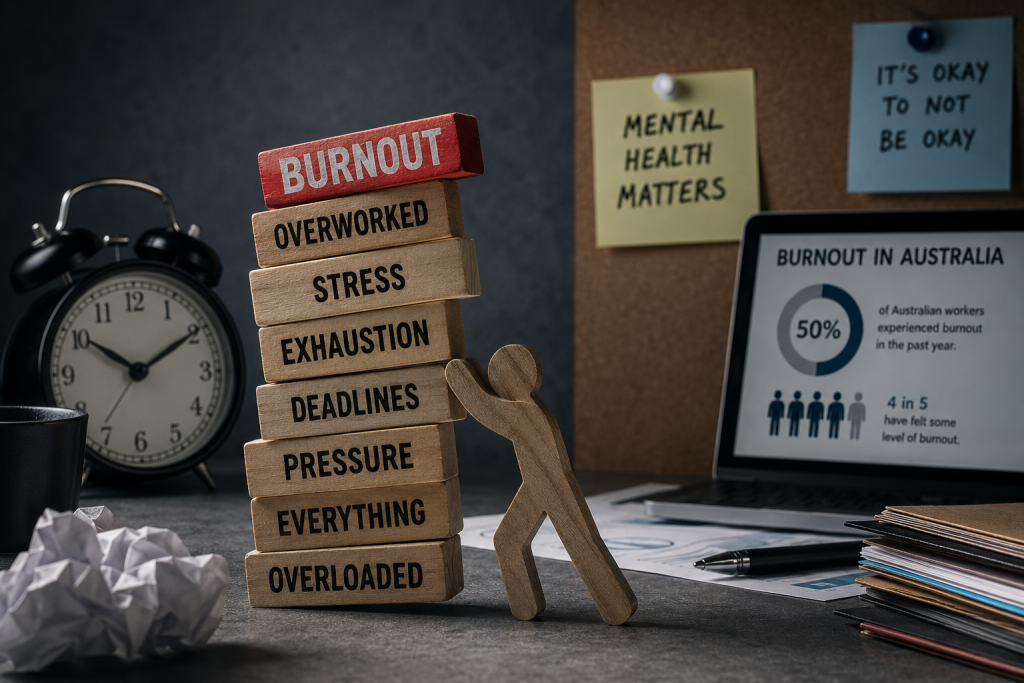
Half of Australian workers admit to having experienced burnout in the past year. However, it’s still a word nobody wants to say out loud in many workplaces. That’s where most of the damage happens. Tara, at CTO shares her insights into what burnout feels like and the practical steps professionals can take to manage it in the workplace.
Half of Australian workers report experiencing burnout in the past year, and four in five have felt some level of it, yet it remains a word many workplaces avoid saying out loud. The gap between how common burnout is, and how rarely it gets named, is exactly where the most damage happens.
The most common causes of workplace burnout include inappropriate workload, lack of management support and inflexible working conditions. Since 2022-24 changes to WHS regulations, Australian employers now carry a positive legal duty to proactively manage these psychosocial hazards, making manager training, not silence, the safer and more effective response.
What’s driving burnout in Australian workplaces?
The data is remarkably consistent across studies. When Australian workers are asked what’s burning them out, three answers keep coming up.
- Inappropriate workload (49%)
- Lack of management support (32%)
- Inflexible working conditions (21%)
Beyond Blue’s 2025 national poll found workload sits at the top by a wide margin, followed by unsupportive management and rigid work arrangements. It’s not just a ‘tough industry’ problem because small business owners report the highest burnout rates of any employment type, higher than full-time employees, casuals or the self-employed. This is because they’re carrying both the operational load and the accountability, with nowhere to delegate either.
Remote and hybrid workers face their own version. A majority of them say it’s harder to switch off after hours, and many feel pressure to be constantly available, which quietly extends the workday without ever officially extending it.
Layer on cost-of-living pressure and the constant digital context-switching between email, chat and meetings, something UNSW researchers have linked to measurable drops in focus and decision quality, and you get a workforce that’s exhausted not because people can’t handle their jobs, but because the way work is structured has stopped accounting for human limits.

Australia isn’t just struggling. It’s struggling more than most
It’s tempting to treat burnout as a universal, unavoidable feature of modern work. The global data says otherwise, and it puts Australia in an uncomfortable spot. Lululemon’s 2024 Global Wellbeing Report found Australia has the most ‘burnout zones’ of any country surveyed. Only 27% of Australian knowledge workers reported a healthy relationship with their work. Our overall wellbeing score came in at 66, behind France (69), the US (69), Singapore (70) and well behind China (79).
The HP Work Relationship Index tells the same story from a different angle. The same 27% figure for Australian knowledge workers with a healthy relationship to work sits just under the global average of 28%, and a long way behind the US (34%), Indonesia (44%), and India (46%). For a country that generally scores well on quality-of-life measures, work is a clear outlier.
That gap matters for how the problem gets framed internally. This isn’t a case of “everyone’s tired everywhere, nothing to see here.” Something about how Australian workplaces are structured, workload norms, management practices, the always-on culture, is producing worse outcomes than comparable economies. That’s a fixable, local problem, not an inevitable global one.
Is burnout hitting everyone equally? No
The averages also hide a real gender gap. The 2025 Women’s Agenda Ambitions Report, run with AGSM at UNSW Business School, found 72% of women reported experiencing burnout in the past 12 months, well above the general workforce figures above.
Part of that comes from outside the office. Roy Morgan’s 2024 data shows that Australian women are still doing 22.3 hours of unpaid domestic work a week, compared to 15.3 hours for men, a ‘second shift’ that compounds whatever load they’re already carrying at work. It shows up in workplace wellbeing scores too: Great Place to Work – Best Workplaces for Women data found women’s wellbeing scores dropped 4 points between 2023 and 2025, with a sizeable gap between the highest-rated employers for women (86% wellbeing) and everyone else (77%).
The takeaway for employers isn’t just ‘support wellbeing’ in the abstract. It’s that flexibility, workload design and management support need to account for the fact that burnout risk isn’t distributed evenly across a team. This is where the same organisational patterns behind presenteeism in the workplace tend to resurface, since both issues trace back to workload and leadership behaviour rather than individual effort.
Not sure where the burnout risk sits in your team?
The burnout stigma is doing real damage on its own
Here’s the part that doesn’t show up in a productivity report. Roughly one in three Australian workers who feel burnt out won’t tell their manager. Not because they don’t trust them, necessarily, but because they’re worried it will be read as weakness, held against them at review time, or used to quietly write them off as not up to the role.
That silence has a compounding effect. Almost half of people experiencing burnout never seek any kind of support for it. Warning signs get missed, or worse, get noticed and ignored, until what could have been addressed with a workload conversation six weeks earlier turns into extended leave, a resignation, or a workers’ compensation claim.
Recent research into workplace discrimination backs this up. People with mental health struggles, including burnout-adjacent conditions, consistently report worse treatment across workplaces than in almost any other setting in their lives. The stigma isn’t imagined. It’s measured.
Why “just don’t say the word” isn’t a safety net?
There’s a common assumption doing the rounds in HR circles: avoid naming burnout, and you avoid the liability that comes with acknowledging it.
It’s a half-truth, and the half that’s missing matters. Burnout on its own isn’t a medical diagnosis. The World Health Organization is explicit that it sits in the category of occupational phenomena, not diseases. So the word itself doesn’t trigger a legal claim.
But the legal exposure was never really about the word. It’s about notice, whether the organisation knew a risk existed and did nothing. And in Australia, that question now has real teeth. Since the 2022-24 changes to the model Work Health and Safety Regulations, businesses have a positive legal duty to proactively manage psychosocial hazards: things like unreasonable workload, poor management support, and low job control, the same list burnout research keeps pointing to as the root causes. That duty exists, irrelevant of whether anyone in the business ever says the word burnout.
In practice, that flips the usual logic. Staying quiet doesn’t reduce risk, it just removes the evidence that anyone was managing it. A documented, proactive response to workload and support issues is a defence. Silence definitely isn’t.
What does this mean for managers?
None of this gets fixed with a wellness webinar or a free meditation app. It gets fixed the same way any workplace hazard gets fixed: by training the people who run teams to spot it early, respond to it properly, and build workloads and support structures that hold up under pressure.
That’s the gap that Corporate Training Options works with organisations to close. Our manager-facing training gives leaders practical tools they can use in day-to-day operations, such as
- How to build and communicate with a strong team?
- How to plan and organise workloads so they don’t quietly become unmanageable?
- How to lead people through change without adding to the pressure?
- How to give constructive feedback that builds trust instead of eroding it?
Those are the same skills that determine whether burnout gets caught early or missed entirely. A manager who communicates clearly, plans realistically, and gives feedback well is already doing most of the work of preventing it, long before it becomes a bigger problem, or a psychosocial risk under WHS law.
These capabilities sit across a few of CTO’s Professional Development streams. Leadership & Management training builds the people-management and feedback skills managers need to catch early warning signs, while Planning & Organisation training addresses the workload design and prioritisation issues that sit at the top of the burnout causes list. For individual staff building their own capacity to manage pressure and change, CTO’s Personal Development programs complement the manager-level work described here.
Discover the right training for your people.
Frequently Asked Questions
What is the difference between burnout and everyday work stress?
While everyday stress tends to be short-term and tied to a specific deadline or event, burnout is a sustained state of exhaustion built up over time. The former eases once that pressure passes, but the latter continues as it usually results from unmanaged workload, low support or inflexible conditions, and doesn’t resolve on its own without a change to the underlying causes.
Why don’t more Australian workers report burnout to their managers?
Roughly one in three burnt-out workers stay silent, largely due to stigma. Many worry it will be seen as weakness, affect how they’re viewed at review time, or be used to question their capability, even when that concern isn’t grounded in how their manager would actually respond.
What is the single biggest driver of burnout in Australian workplaces?
When it comes to Australian workplaces, iInappropriate workload is clearly the leading cause, cited by 49% of Australian workers according to Beyond Blue’s 2025 national poll. This factor is well ahead of the two other most common factors, i.e., lack of management support (32%) and inflexible working conditions (21%).
Is burnout classified as a medical condition in Australia?
No, it’s not. The World Health Organization defines burnout as an occupational phenomenon rather than a medical diagnosis. However, this does not remove an employer’s legal obligations, since Australian WHS regulations require proactive management of the underlying psychosocial hazards regardless of diagnostic labels.
How do Australia’s WHS regulations affect an employer’s burnout obligations?
Since the 2022-24 changes to the model Work Health and Safety Regulations, Australian businesses carry a positive legal duty to proactively manage psychosocial hazards such as unreasonable workload and poor management support. This duty applies whether or not burnout is ever formally named within the organisation.
Who is most at risk of burnout in Australian workplaces?
Small business owners report the highest burnout rates of any employment type, and women report notably higher burnout rates than the general workforce, at 72% compared to the wider population figures. Remote and hybrid workers also face elevated risk due to difficulty switching off after hours.
Can manager training alone prevent workplace burnout?
Manager training addresses the core drivers most directly, since workload design, communication and support all sit within a manager’s control. While it cannot remove every external pressure staff face, equipping leaders to spot early warning signs and act on them is consistently more effective than wellness initiatives alone.
How does Australia’s burnout rate compare with other countries?
Australia recorded the most ‘burnout zone’ of any country in Lululemon’s 2024 Global Wellbeing Report, with only 27% of knowledge workers reporting a healthy relationship with work, behind France, the US, Singapore and China. This suggests the issue is shaped by local workplace structures rather than being an unavoidable global norm.
Build the Leadership Capability That Catches Burnout Early
Burnout isn’t solved with a single policy update or a one-off wellness session. It’s addressed the way any workplace hazard is addressed: by equipping the people who manage teams day to day with the skills to recognise it, respond to it, and prevent it from building up in the first place.
CTO’s Leadership & Management training gives your managers the practical, real-world tools to lead through pressure without adding to it, backed by over 30 years of experience delivering customised Professional Development programs across Australia.
Ready to equip your leaders against burnout?